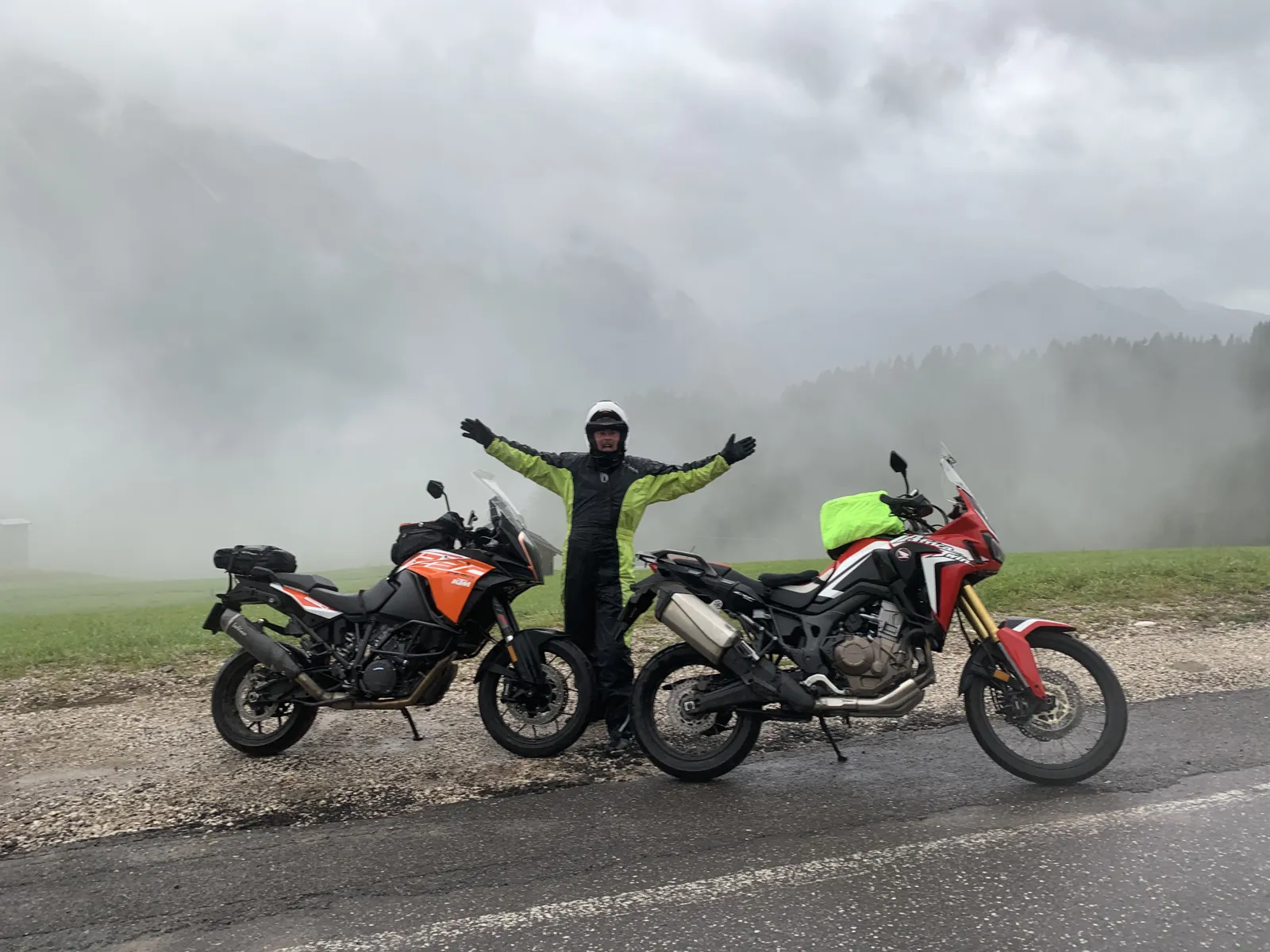
Rich near San Giovanni di Fassa, Italy — arms out, waterproofs on and the mountains hiding somewhere behind the mist. Winter riding at its most optimistic.
This article contains affiliate links. If you buy through them, I may earn a small commission at no extra cost to you. More info.
Winter riding is not summer riding with an extra jumper—unless you’re a bike journo from Finland.
The bike feels different, the tyres feel different, the roads feel different—and I definitely ride differently. But that doesn’t mean the motorcycle has to disappear into the garage the moment the temperature drops.
A bright winter day can be brilliant: quiet roads, sharp views, fresh air and, best of all, a proper cup of tea at a biker café after a chilly ride. Tea has no business tasting as good as it does after an hour in the cold, but somehow it always does.
The key is adapting. Looking after the bike, keeping myself warm, riding smoothly and knowing when the sensible option is to stay at home.
Start With the Bike
Before I put my helmet on, I check the basics.
Tyres come first. I check pressures, tread and general condition, and I check the pressures when the tyres are cold. Cold tyres and cold roads don’t behave like they do in summer, especially in shaded areas, on bridges and anywhere the sun hasn’t reached.
I also pay more attention to the battery. A motorcycle battery can be perfectly healthy all summer, then suddenly decide it’s emotionally unprepared for a frosty morning.
Lights matter more too. Winter often means darkness, low sun, mist, rain and spray. I want to know the headlight, brake light and indicators are all working—and I keep the lenses clean. Winter road grime gets everywhere, including places it has absolutely no right to be.
After salty or wet rides, I clean the bike properly, especially the chain, brakes, wheels and exposed fasteners. In winter, cleaning isn’t vanity. It’s maintenance.
Stay Warm—But Still Be Able to Move
Winter clothing has to do two jobs: it’s got to keep me warm and dry, but it’s also got to let me move properly on the bike.
I still need to turn my head, look through a corner, work the controls and get on and off the motorcycle without feeling like I’ve been wrapped in a duvet.
Most modern waterproof motorcycle suits do a good job. Many have removable thermal and waterproof layers, and a decent Gore-Tex-style suit can handle far more weather than people think.
Even so, I like to put a lightweight fluorescent rain jacket over my normal gear. It adds another barrier against wind chill, helps in prolonged rain and makes me much more visible when the weather goes grey. If you need one, Chromeburner has a good range of motorcycle rain gear.
Cold hands are what usually end a winter ride first. Heated gloves, a heated vest or a heated jacket can make winter riding far more comfortable, and if my core temperature is right, my hands and feet tend to cope better too. If you’d rather not wire anything up, a warm waterproof glove such as the Held Score 4.0 Gore-Tex is a solid choice for cold, wet days.
There’s a fine line between being sensibly layered and walking like a well-protected penguin. The trick is staying warm enough to concentrate, without becoming so bulky that operating the indicators turns into an advanced engineering exercise.
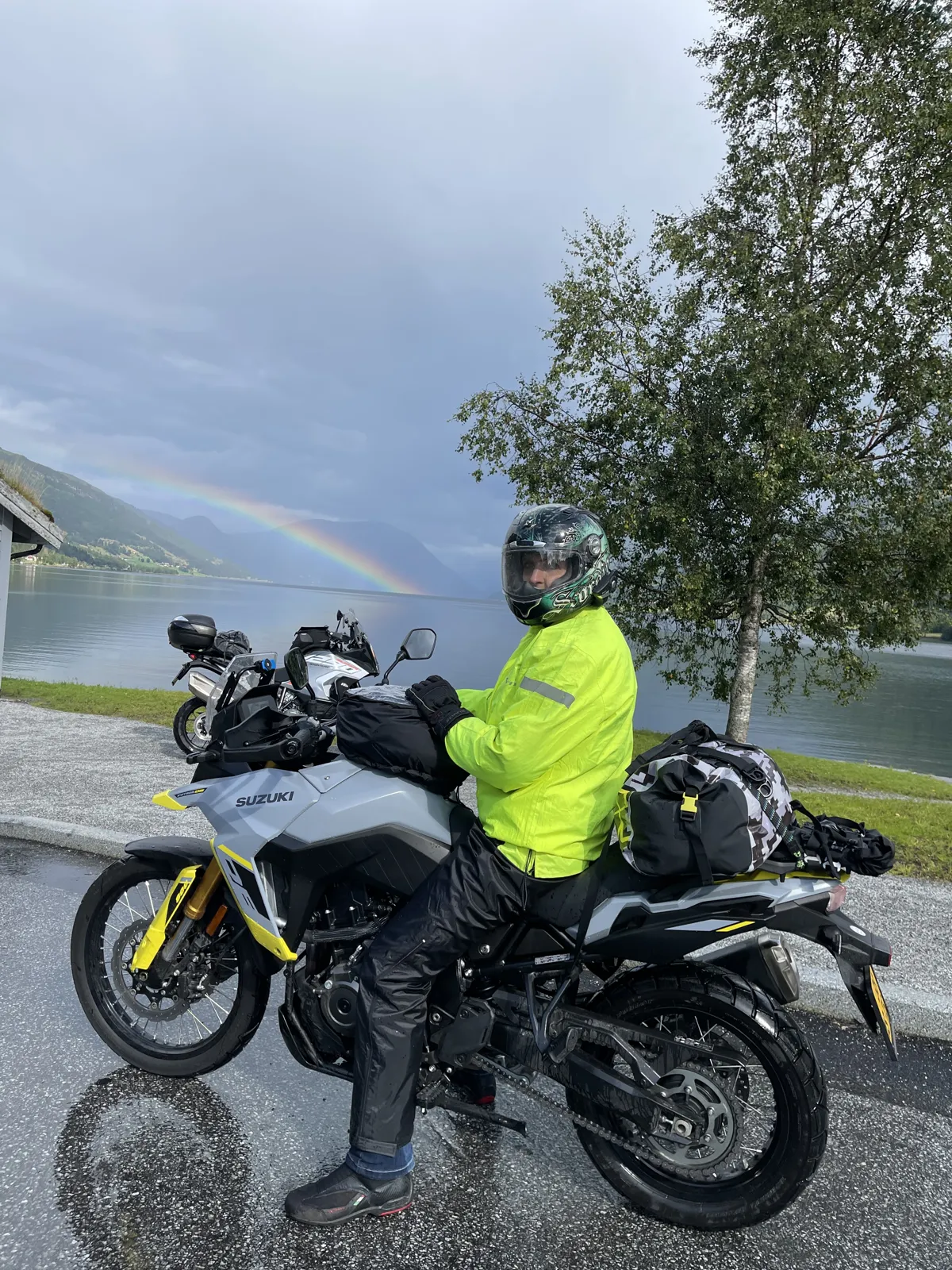
Belinda on her grey Suzuki in Vassenden, Norway — overlooking Jølstravatnet Lake, with a rainbow appearing just in time to make the rain feel worthwhile. Her fluorescent over-jacket is similar to this RST Flo Rider waterproof jacket.
Rain Changes Everything
When the roads are wet, I don’t just slow down and ride exactly as I would in summer.
I leave more room, brake earlier, use gentler throttle and steering inputs, and look much further ahead. I’m constantly watching for standing water, mud, wet leaves, diesel, painted road markings and anything else that might reduce grip.
A wet road isn’t automatically dangerous, but I don’t assume it has the same grip as dry tarmac in July. Within a few metres, I can go from clean road surface to a drain cover, a white line, wet leaves and a patch of mud. That’s more than enough excitement for one corner.
A weather app can tell me it’s “partly cloudy.” It rarely mentions the sideways rain waiting around the next village.
During the 2020 Cannonball Bike Run in Italy, the weather became bad enough that plenty of riders took a shorter route to the hotel. Rich carried on and completed the proper route—although being wet, cold and determined wasn’t quite the same thing as enjoying it.
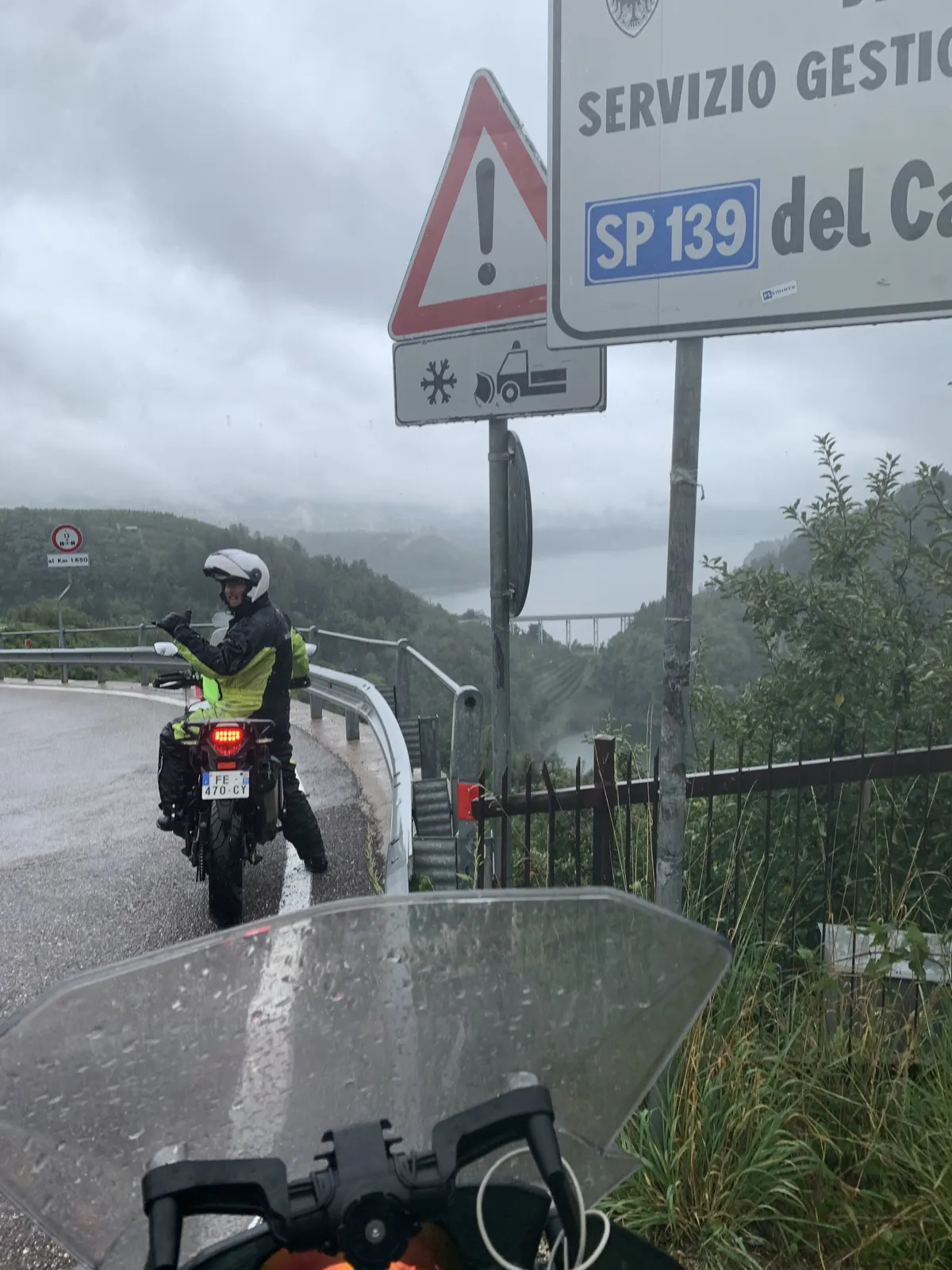
Rich, Italy, during the 2020 Cannonball Bike Run — rain, low cloud and a road sign warning that the weather was only going to get more interesting. One of the few riders who completed the proper route that day, while plenty of others wisely—or conveniently—took the shorter way to the hotel.
Smooth Is the Winter Secret
In winter, I try to get most of my braking done while the bike is upright. Then I can enter a corner at a speed I’m comfortable with and concentrate on riding through it smoothly.
I’m not trying to prove anything.
I want smooth braking, smooth steering, smooth throttle and smooth acceleration. The less I demand from the tyres, the more grip I have available if the road decides to surprise me.
Wet leaves, road markings, drain covers and mud are all worth respecting. If I spot them early, I slow down before I reach them and keep the bike as upright and relaxed as possible.
The earlier I see a hazard, the more options I have. And having options is one of the things I value most on a motorcycle.
Frost Is Different
Rain is manageable. Frost is something else.
A wet-looking road may not be wet at all. It could be frozen, especially on bridges, in shaded lanes, under trees or where water tends to gather.
If the road looks shiny in the shade, I don’t assume it’s giving me a friendly welcome.
Black ice is not something I want to experiment with. It doesn’t matter how new the tyres are, how capable the bike is or how much technology it has. If there’s effectively no grip, there isn’t much any motorcycle can do for me.
If I genuinely think there’s ice on the road, I don’t ride. There’s no prize for being brave, and no ride is worth discovering how much faith I have in traction control and my own optimism.
Plan the Ride, Not Just the Route
Winter makes me think differently about route planning.
I consider altitude, shaded roads, exposed bridges, wind, possible mud on country lanes and where I can stop for a warm drink. I also check the weather for later in the day, not just the view outside when I leave home.
A 200-mile winter ride isn’t automatically better than a 100-mile one.
The best winter ride isn’t the longest one. It’s the one that doesn’t end with me explaining to Belinda why the motorcycle is now stored in several separate pieces.
A shorter ride on a crisp, dry day can be perfect. Quiet roads, clear views and a café stop can be far better than forcing big mileage through rain, wind and fading daylight. If you’d like a winter-friendly route planned around the conditions, take a look at my tailor-made motorcycle routes.
Have a Plan B
I always carry the basics: phone, charging cable or power bank, simple tools, tyre-repair kit, inflator, spare gloves, waterproof layer, torch, reflective item and water.
The exact kit depends on the journey. A run across town isn’t the same as a day in the mountains.
I also don’t wait until I’m freezing before I stop. Once my hands are cold, concentration is fading and I’m thinking more about the nearest radiator than the next bend, I’ve left it too long.
A coffee, food and ten minutes somewhere warm can make a huge difference. It also gives me a chance to check the bike, look at the weather again and decide whether carrying on is still the right call.
Why I Still Ride in Winter
Winter riding can be hard work—but it can also be brilliant.
The roads can be quieter, the scenery can be sharper and a familiar route can feel completely different. Sometimes the weather is miserable. Sometimes the waterproofs earn every penny. And sometimes you get rain, mist, mountain views and a waterfall all on the same ride.
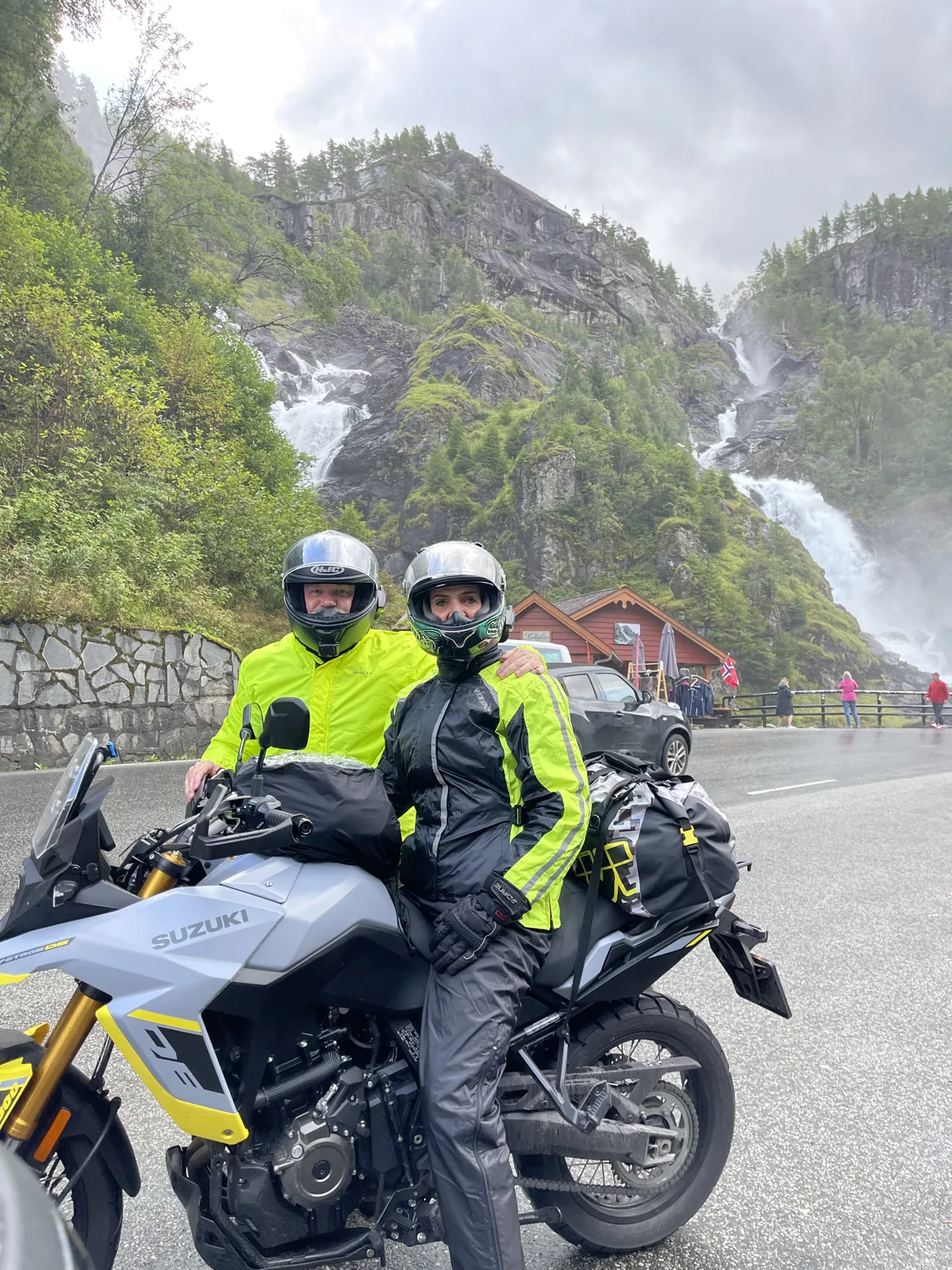
Alan and Belinda, Norway — very wet roads, a spectacular waterfall and enough waterproof clothing to survive an accidental trip through a car wash.
For me, the most important winter riding skill isn’t braking, cornering or throttle control.
It’s judgement.
Knowing when to slow down. Knowing when to stop. Knowing when to turn around. And knowing when the conditions are good enough for a brilliant day on the bike.
Stay warm. Stay visible. Stay smooth. And never underestimate the restorative powers of a cup of tea.
— Alan | Motorcycles & Legends
Winter gear I recommend
- Heated motorcycle gloves — compare Richa, REV’IT!, Ixon, Macna and Held
- Motorcycle rain gear — jackets and trousers that pack small
- RST Flo Rider waterproof jacket — fluorescent waterproof over-jacket, like the one Belinda wears
- Held Score 4.0 Gore-Tex winter gloves
More picks on my Links page.