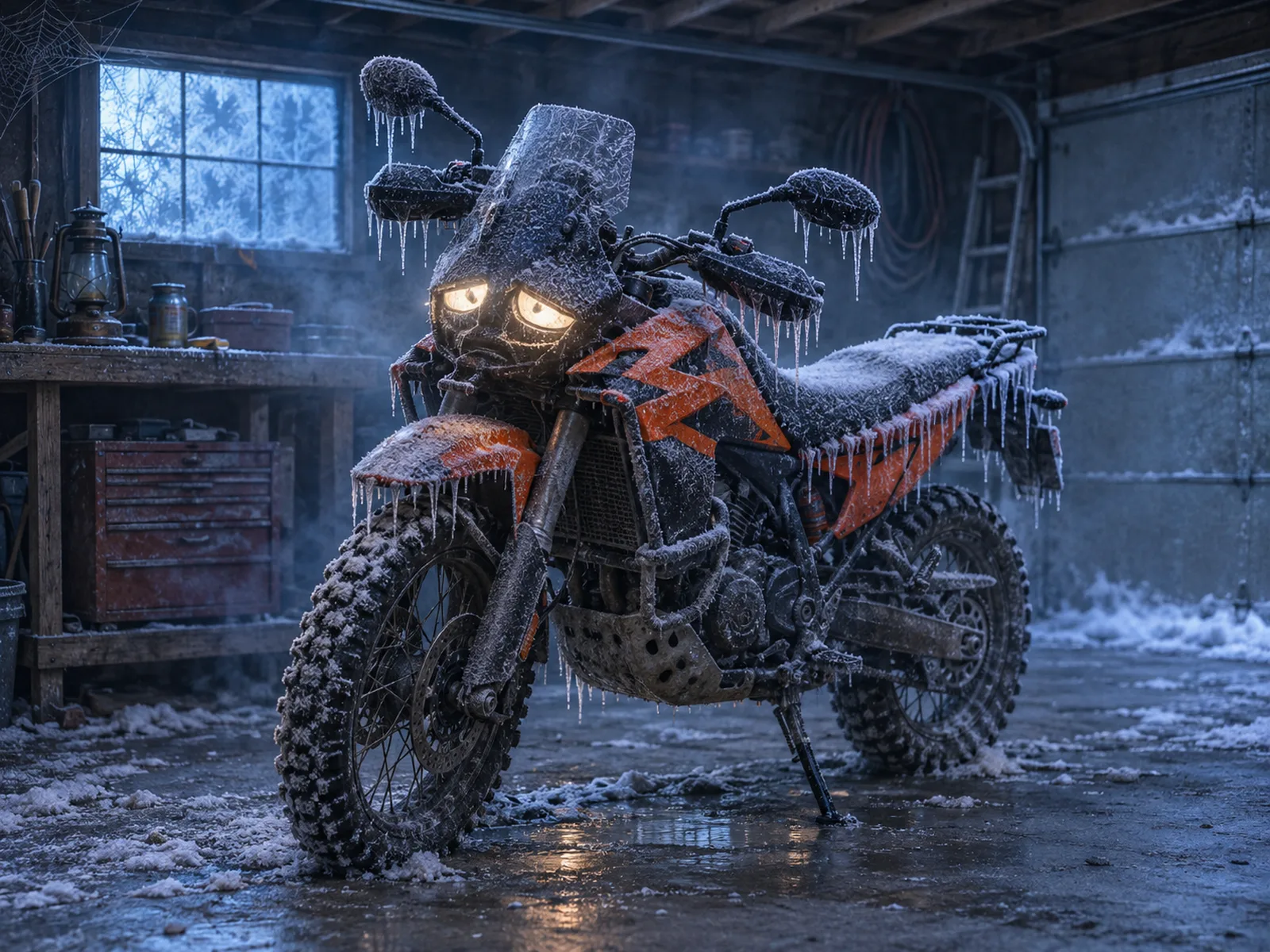
Every winter, in a cold garage somewhere, a motorcycle sits under a layer of frost wondering what it did wrong. (Illustration.)
This article contains affiliate links. If you buy through them, I may earn a small commission at no extra cost to you. More info.
You’ve probably seen the sign: “If you’re cold, they’re cold. Bring them inside.”
It’s meant for dogs, but it works just as well for your motorcycle battery. And if I could get the whole bike through the back door without the other half noticing, I’d bring that in too.
Let’s be honest, nobody gets excited about putting the bike away for winter. The evenings draw in, the roads go grey and greasy, and suddenly the thing you’ve been riding every weekend is sat in the garage looking at you like a dog that knows it’s not going for a walk.
But a bit of effort now saves a lot of swearing in spring. A flat battery, a furry chain, sticky brakes and a tank full of stale fuel are all avoidable, and most of it costs very little. Whether you’re tucking the bike up until March or you’re one of the hardy lot who rides right through, this is what actually matters.
Most of the kit I mention is linked, and with Christmas around the corner it would make a decent present for your motorcycle, your motorcycle mates, or yourself. I won’t tell anyone.
Clean It Before You Put It Away
This is the one people skip, and it’s the one that bites hardest. Put a bike away dirty and the road grime, dead flies and, worst of all, road salt sit on your paint, alloy and fasteners for months. Salt and moisture together are basically a rust factory.
Give it a proper wash with a dedicated motorcycle cleaner rather than washing-up liquid, which can strip protective waxes. Get into the hidden bits: under the mudguards, round the swingarm pivot, the engine cases and the back of the wheels. If you’re starting from scratch, the Muc-Off Ultimate Motorcycle Care Kit has the cleaner, protectant, polish and brushes in one box.
Then dry it properly. A leaf blower is brilliant for getting water out of switchgear and bolt heads, and a short ride afterwards drives off whatever’s left. A coat of wax on the paint and a polish on the chrome gives it an extra layer of armour for the months ahead.
Fight the Rust
Once it’s clean and dry, protect the metal. A good anti-corrosion spray creeps into seams and round fasteners and leaves a film that keeps moisture off. Treat the engine cases, exposed fasteners, wheel spokes and hubs, fork lowers below the seals, footpeg hangers, brackets and electrical connectors. The ROKiT-OFF Winter Pack is a handy way to get started, with an anti-corrosion spray, a degreaser, fuel treatment and cloths in one box.
One important thing: keep anti-corrosion sprays and lubes well away from your brake discs, pads and tyres. A light mist on a breezy day ends up exactly where you don’t want it. Mask the discs off first, and if some does land on them, clean it straight off with a brake cleaner such as Motul P2 Brake Clean. If oil has soaked into the pads themselves, no cleaner will save them. Replace them.
Chain: Clean It, Then Lube It
A dirty, dry chain can grow stiff links and surface rust surprisingly quickly over winter. Spraying fresh lube on top of the muck is only half the job; you’re just sealing the grit in.
Rinse the chain, spray on a cleaner like Muc-Off Chain Cleaner, leave it for five minutes and get in there with a chain brush. Once it’s dry, lube it. An all-weather lube such as Muc-Off All-Weather Chain Lube works well. Spray the inside of the chain as you turn the wheel, so the sprockets get a coat too, and leave it to soak in overnight. It’s a lot easier with the back wheel off the ground, which brings me neatly to stands. More on those in a minute.
While the lube’s out, give the side stand, footpegs, lever pivots and cable ends a drop too.
If You’re Cold, It’s Cold: The Battery
Batteries hate the cold and they hate being ignored. Even with the ignition off, plenty of modern bikes have alarms, trackers, clocks and ECUs that sip a little current, and over a few weeks that’s enough to flatten a battery. Leave it flat long enough and it may never fully recover.
If you’ve got electricity in the garage, fit a smart charger, also called a battery tender, optimiser or maintainer. It watches the battery and only tops it up when it needs it, so you can leave it connected all winter. Two things to check first: lithium batteries need a charger that specifically supports lithium, and some bikes, BMWs especially, need a CAN-bus compatible charger or adapter. The Optimate 4 Gold Quad Program covers both, and comes with a lead you can leave fitted to the battery so plugging in takes seconds.
No electricity in the garage? Take the battery out and bring it indoors. Somewhere cool, dry and frost-free is ideal: a utility room or under the stairs, off the floor and away from radiators and small children. Pop it on the charger every few weeks, or just leave it connected.
When you take it out, disconnect the negative first, then the positive. When it goes back in, positive first, then negative. And take a photo of the wiring before you start. Your spring self will thank you.
Fuel Goes Off (Like Milk, Only Smellier)
Modern petrol, especially E10, doesn’t keep the way it used to. Over a few months it can go stale, pick up moisture and gum up injectors or carburettors.
Fill the tank close to full before storage, so there’s less air space for condensation and less chance of rust inside a steel tank. Add a fuel stabiliser such as ROKiT-OFF Fuel Stabilizer, then run the engine for a few minutes so the treated fuel gets right through the system. If you can, make that last tank E5 or super unleaded. Carb bikes going away for a long time may be happier with the float bowls drained.
Riding through on E10? A fuel system cleaner such as Motul Boost and Clean every so often keeps the injectors happy. It’s a cleaner, mind, not a storage stabiliser.
Fresh Oil for the Long Sleep
It sounds backwards, but change the oil and filter before storage, not after. Used oil carries acids and combustion by-products that can sit and work on the inside of your engine all winter. Fresh oil means it’s sleeping in clean sheets. Lay an absorbent motorcycle mat down first and you won’t be scrubbing the garage floor afterwards.
While you’re at it, check the coolant is strong enough to cope with frost, and if the brake fluid is dark or due a change, winter is the perfect time to do it.
Get the Weight Off the Tyres
A bike sat in the same spot for months can develop flat spots, and tyres slowly lose pressure anyway. Pump them up to the correct pressure before storage. A cordless inflator like the Oxford MicroJet or the ROKiT-OFF Tire Inflator lets you set the pressure and walk away; it stops when it gets there.
Better still, get the bike up on stands. A rear paddock stand such as the RideRR Universal Pro takes the weight off the back and makes chain jobs a doddle, and a front stand like the Oxford Zero-G Lite sorts the other end. Always lift the rear first, then the front, and check the stand suits your bike before you buy. Stuck with just a side stand? Roll the bike a little every few weeks so the same bit of rubber isn’t doing all the work, and keep the tyres off cold, damp concrete with a mat or a bit of old carpet.
To Start or Not to Start?
If you want to start your engine now and then over winter, that’s fine, but make sure you run it up to temperature, ie fully warm. Otherwise, leave it alone.
A quick start for a minute or two and then switching it off does more harm than good. It causes condensation in the engine and exhaust and drains the battery without giving it a chance to charge back up.
If you do start it, let it get properly warm, with the fan cutting in if it’s liquid-cooled. Do it outside or with the garage door wide open, never in a closed space. Pop the battery back on the charger afterwards. And if you get a dry, salt-free day, forget all that and take it for a proper ride.
Keep the Mice Out
Rodents love a quiet garage and a cosy airbox. They’ll nest in it, chew the wiring and generally cause the kind of chaos you won’t discover until spring. Plug the exhaust and the airbox intake with a bung or a rag, keep bird seed and pet food out of the garage, and stick a big note on the clocks to remind yourself to take the plugs out before you start it. It’s the cheapest bit of insurance you’ll ever buy.
Pick the Right Cover
A cover is one of the simplest and best things you can buy, but the type matters.
Indoors, you want something soft that keeps the dust off but lets moisture escape. Never use a plastic sheet or tarp indoors; it traps condensation against the bike and does more harm than good. A lightweight cover such as the Oxford Solatex is good in a garage or carport. It’s water-repellent rather than fully waterproof, so it’s best kept somewhere sheltered.
Outdoors, you need a properly waterproof cover with a strap underneath, so it doesn’t turn into a parachute in the first gale. The Rebelhorn Shelter, the Richa Premium and the MKC Moto cover are all built for outdoor use. Got a top box? A normal cover often won’t stretch over it, so look at one shaped for it, such as the DS Covers Alfa (Top Case), which also has vents to stop condensation building up underneath.
Whichever you choose, let the bike cool down fully before the cover goes on, and in a proper storm it’s safer to take it off.
Keep the Garage Dry
Damp is the real enemy. If your garage suffers from condensation, a dehumidifier makes a massive difference, and even a few moisture-absorbing tubs help in a small space.
Paperwork and Downtime
Check whether your insurer offers laid-up cover for the months the bike isn’t being ridden. Depending on where you live, you may also be able to take it off the road officially, such as SORN in the UK or suspending the registration (schorsen) with the RDW in the Netherlands. Read the rules carefully, though; you usually can’t ride it, or even park it on a public road, while it’s off the road.
And use the downtime. Winter is the best time of year to sort the jobs you’ve been putting off: suspension service, worn levers and grips, brake caliper sliders, those accessories still in their boxes. Or, my personal favourite, planning next year’s routes. Have a look through the GPX Library, or if you’d like something built around you, my tailor-made motorcycle routes.
If You’re Riding Through Winter
Some of us just can’t hang the keys up. If that’s you, the job changes from protecting a parked bike to protecting one that’s getting hammered by salt and grit.
Salt is public enemy number one. Give the bike a generous coat of anti-corrosion spray before the gritters come out and top it up every few weeks. After every salty ride, rinse it off as soon as you can. Many riders use cold or lukewarm water rather than hot, which is widely believed to speed up the salt’s work. Then dry it and re-protect the vulnerable bits. Keep the chain lubed too, because salt and grit turn it into grinding paste.
Heated grips are probably the best winter upgrade you’ll ever fit, hand guards keep the wind off your fingers, and a fender extender stops the front wheel firing salt all over the engine. Check your tyre pressures more often as well; the cold drops them.
For the riding side of things, from staying warm to dealing with wet and frosty roads, have a read of my guide to riding a motorcycle through winter.
The Spring Wake-Up
When the sun finally comes out, don’t just jump on and go. Run through this first:
- Remove the exhaust and airbox plugs (that note on the clocks is your friend).
- Refit the battery: positive first, then negative.
- Check tyre pressures and look for cracks or flat spots.
- Check oil, coolant and brake fluid levels.
- Pump the brakes a few times and make sure they bite properly.
- Make sure no anti-corrosion spray is near the brakes or tyres, and wipe it off the exhaust before it gets hot. If in doubt, give the discs a wipe with brake cleaner.
- Check the chain tension and lube it.
- Test every light, the indicators and the horn.
- Start up, let it warm up and take the first few miles gently.
Then get out there. You’ve earned it.
Final Thoughts
Looking after a motorcycle over winter doesn’t take much time or money. A clean bike, a looked-after battery, a decent cover and a bit of anti-corrosion spray will prevent most of the problems riders find in spring. Do that, and your bike won’t end up looking like the sad one at the top of this page.
Stay warm, keep the battery indoors, and I’ll see you on the road in spring. Or sooner, if the sun shows up.
— Alan | Motorcycles & Legends
Winter storage kit I recommend
MKC Moto (Benelux)
- Optimate 4 Gold Quad Program — smart charger for lead-acid and lithium batteries
- Muc-Off Ultimate Motorcycle Care Kit — everything for the pre-storage wash
- ROKiT-OFF Winter Pack — anti-corrosion, degreaser and fuel treatment
- Muc-Off Chain Cleaner, RideRR Chain Brush and All-Weather Chain Lube
- ROKiT-OFF Fuel Stabilizer and Motul Boost and Clean
- Motul P2 Brake Clean
- RideRR Universal Pro Paddock Stand and ROKiT-OFF Tire Inflator
- Covers: MKC Moto, Richa Premium and DS Covers Alfa (Top Case)
Chromeburner (Europe and beyond)
- Oxford Zero-G Lite Front Stand
- Oxford MicroJet Cordless Tyre Inflator
- FC-Moto Premium Motorcycle Mat
- Covers: Oxford Solatex (indoor/sheltered) and Rebelhorn Shelter (outdoor)
Not sure what your riding mate needs for Christmas? An MKC Moto gift card lets them choose. More picks on my Links page.

